Monday, June 1, 2020

Science Fiction and Religion (Part 1 Super Heroes)


Super Heroes

If you want to start an argument at your favorite neighborhood tavern, backyard BBQ, church social or any city block in the country, suggest that religion and science fiction are comparable. If we are open minded, there is considerable intermingling in religion and sci-fi to ponder.

Gods and saints appear regularly in comic books with characters such as Thor, Hercules, Wonder Woman, Isis as well as the Judeo Christian God. Religious texts offer larger than life heroes such as Samson who, like Hercules, had tremendous strengths and multiple vulnerabilities. Moses could turn his staff into a snake. Jesus had amazing abilities including the ability to defy death like Deadpool or Wolverine.

Many "true believers" are willing to suspend belief and have faith that Superman could fly in a gravity well such as Earth's, or that Noah could cram hundreds of wild animals into a wooden boat outfitted with adequate feeding stations and waste disposal facilities. 

The major difference between sci-fi and religion is thus: science fiction is "fiction", made-up tales to inspire, guide and explore the glories and failures of humanity. The major religions consider their tenets and teachings as "nonfiction" and not to be challenged on threat of retribution by a supernatural being or fanatical followers. Likewise, religions seek to inspire, guide and explore the glories and failures of humanity. 

Not all sci-fi fans are atheists. Many consider that there is a higher being; a spiritual purpose and moral compass to follow. Church goers can go to movies and cheer the exploits of Spiderman or the Avengers and not feel that their faith is being challenged.

Science and technology has long inspired writers and artist to delve into sci-if. Historically, there are founders of religions who were real humans and crusaders with phenomenal abilities.

People of African descent have thousands of religious sects. Some of their deities have crossed over to the speculative fiction realm. Brother Voodoo is a good example. He was a Black sorcerer from Haiti who took over for Dr. Strange, the Sorcerer Supreme.

Black and brown societies are not strangers to amazing technology — there are engineering marvels throughout Africa and the Americas since ancient times. These scientists and technologists have produced  stories to be absorbed by the masses.

It is up to each person to chose what to believe in to feel whole. We need our super heroes in science fiction and religion. 

Wakanda Forever!


Wednesday, February 26, 2020

The Most Fearful Aspect of Sci-Fi

Science Fiction is highly political.


In the beginning,  Captain Nemo voyaged his futuristic submersible invention "The Nautilus" deep underwater during the 1800s to confront deep-sea monsters and vicious human greed.  Later, Samuel Delany gave us fantastic excursions throughout the Galaxy and into the depts of exploding stars and decaying civilizations in the award-winning novel Nova. Octavia Butler's final literary expeditions pushed readers into a cataclysmic new religion, failed government and persistent human survival.

Many sci-fi authors offer terrifying tales of dystopia. Read 1984 by George Orwell, The Iron Heel by Jack London, Stranger in a Strange Land by Robert Heinlein,  or Little Brother by Cory Doctorow. Likewise, George Schyler's classic Black Empire is essentially a retelling of a 2nd American Civil War on a global scale where (Spoiler Alert!)  Black people win, almost.

A plethora of writers has created vivid stories and world-building scenarios that deserve to be examined because of their futuristic visions of society and how we should be governed for good or bad. It can be argued that the innate appeal of Sc-Fi is its presentation of politics in the past, present, and future.

One of my favorite themes is Kirk(s)/Federation vs the Klingons. The Klingons are the most diverse, endearingly complicated humanoid species in all of Star Trek lore (next comes the Vulcan/Romulans closely followed by the Borg). In CBS's Picard,  powerful adult themes involving sex, race, and politics makes the series entertaining and thought-provoking (far beyond the childlike trivialities of Star Wars.)

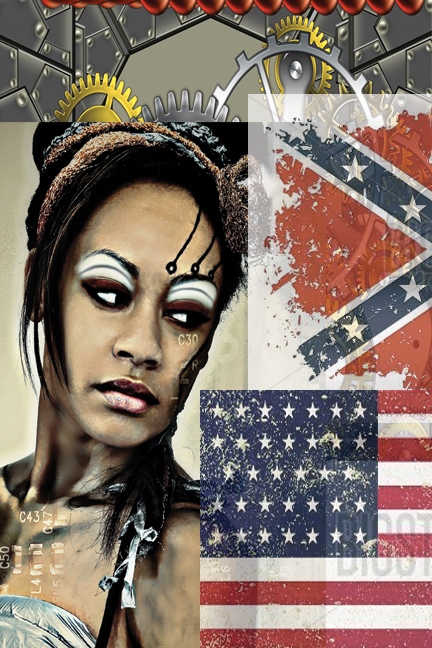
In speculative fiction, we are experiencing the American Civil War and the contradictions of our inner selves over and over again in outer space and multi-universes. This creates artistic opportunities for new solutions to old problems.

Thoughts to Ponder: Politicians and elected officials need sci-fi to prepare a better future for all of us.  Read. Write. Perform. 


Saturday, September 7, 2019

Preview: The AFROFuturist Bible Part One

I am currently writing a novella called "The AFROFuturist Bible".  In the next few blog posts, I will be offering to my readers, a fictional exploration of religion, myths and AFROFuturism. Enjoy. Comments, criticisms, and questions are welcome.  -- Stafford L Battle

Credits: Music by Otis McDonald (YouTube Audio Library); Art from Pixabay

____________________________________

Part One


Introduction:


Two grime-encrusted intruders wearing patchwork military gear approached my private picnic on the beach. Online Social Media had promised me a pristine parcel of manicured green grass on the sultry west coast of Africa where persistent ocean waves smashed rhythmically against jagged rocks. 

I had surrendered polished, antique Roman gold coins to ensure exquisite cuisine, anonymity and sharp salty breezes for romantic tranquility to charm an enchanting female by displaying my wit, wealth and masculine prowess. The distant strangers hoisted rusty, Asian-manufactured, semi-automatic weapons. Prey masquerading as predator; a desperate tactic in hostile times. 

 This was a distressing distraction. 


It brought to mind, the first prophecy in my AFROFuturist Bible:  “Mami Wata rules us all. The strong will always succeed until the weak get smarter.” I had written it, I own it, and it haunts me in my dreams and when I awoke in tangled sheets of cotton. When you swear an oath to celestial beings, there is very little wiggle space, limited possibilities to dishonor your commitment without suffering dire consequences. 


 I expected ruinous retribution for any transgressions against Mami Wata, the Eternal African Matriarch and founder of all human religions and mythologies on this world. I wondered if this was just another test of my resolve — what or who was I willing to sacrifice?


****** Just a taste of my story . . .  more to come*****


Saturday, May 18, 2019

Podcast Alert: My Amazing Aunt Raven Part 2

Part Two of "My Amazing Aunt Raven" is now available online. 


I offer my sincere thanks to  Ariel Therkiel for her excellent work to promote AFROCentric speculative fiction. We must support creators like her.

Be sure to visit her Patreon Page at: https://www.patreon.com/talesfromablackuniverse


Listen to Part Two of "My Amazing Aunt Raven" Is Here!

https://soundcloud.com/talesfromablackuniverse